
Spanish Banks Put Syndicated Lending on Blockchain
In brief
Current as of 2026-10-12.
- Iberdrola, BBVA and Santander arranged a €150 million corporate syndicated facility managed using distributed ledger technology (DLT), commonly known as blockchain.
- BBVA describes it as the first live syndicated loan whose full lifecycle is administered this way.
- The platform covers execution and disbursement as well as interest, waivers, repayments, assignments and maturity.
What changed
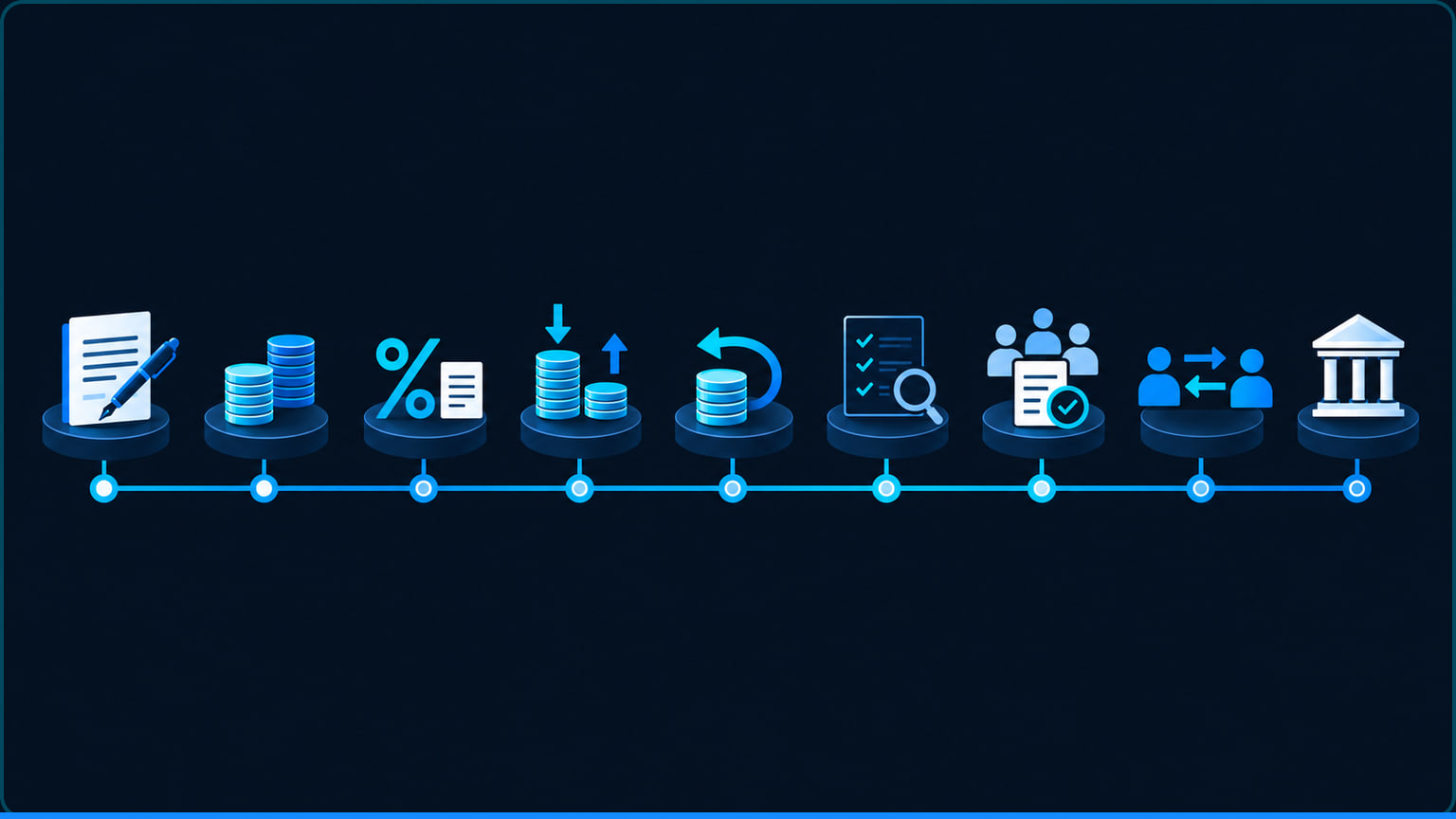
The transaction extends blockchain’s role beyond recording a loan’s initial arrangement: the shared platform administers the facility throughout its lifecycle. Iberdrola, BBVA and Santander arranged the €150 million corporate syndicated facility using DLT. BBVA describes it as the first live syndicated loan whose entire lifecycle is administered with this technology, from execution and disbursement through interest, waivers, repayments, assignments and maturity. The full-lifecycle scope means the platform is intended to cover events after the loan is first arranged as well as its initial execution.
BBVA says the infrastructure gives participating institutions one synchronized, immutable information record, replacing reconciliation between separate databases. Authorized participants can see recorded events in real time. The appointed agent bank retains operational control over how participating institutions interact with the platform. In this arrangement, the shared record provides a common view of events while the agent bank remains responsible for operational control.
The platform coordinates contractual events over the life of the loan. These include interest calculations and notices, principal and fee payments, early repayments, covenant monitoring, certain consents and transfers of lender participations. The events are recorded on the DLT infrastructure and are visible in real time to authorized participants. This scope links the platform’s shared record to ongoing servicing tasks as well as the transaction’s execution and disbursement.
BBVA and Santander say the platform was developed by ioBuilders with their support. After this first transaction, the institutions plan to onboard further participants and expand the platform’s functions. That is a stated plan following the initial transaction; it does not establish how quickly new participants will join or what results expansion will produce. BBVA’s announcement.
Section source: Iberdrola, BBVA and Santander deliver the first syndicated financing managed entirely on blockchain.
Why it matters
Syndicated loans involve a borrower, an agent bank and multiple lending institutions coordinating information and contractual events. When those parties use separate databases, they have to reconcile information between them. BBVA says the platform replaces that reconciliation with a single synchronized, immutable record shared by participating institutions. Authorized participants can see recorded events in real time, giving them a common view of the information recorded on the platform.
The system’s scope includes events that arise at different stages of the loan. It covers execution and disbursement, then events such as interest calculations and notices, principal and fee payments, early repayments, covenant monitoring, certain consents, lender transfers and maturity. Coordinating those events in a shared record extends the platform’s role beyond the initial arrangement. It is an operational use of DLT in the administration of a syndicated facility.
The transaction also clarifies the agent bank’s role in the arrangement. Participating institutions interact under the operational control of the agent bank appointed for the financing. The platform supplies the shared information record, while the agent bank retains operational control over participant interactions. Both points matter when considering how a common record fits into a loan involving several institutions.
Cinco Días independently reported the €150 million transaction and described the platform as recording loan events in a synchronized, immutable record visible in real time to authorized participants. Its coverage also identifies the platform as developed by ioBuilders and says the institutions expect further participants to join as its functions expand. Cinco Días’ coverage of the transaction corroborates the transaction and the reported features of the shared record.
The business case remains to be demonstrated. The firms present reduced operational-error risk, lower operating costs and improved coordination as possible benefits. They also say the approach may help increase market liquidity and facilitate access to this type of financing for mid-sized companies by simplifying processes that have traditionally limited their participation. The announcement does not provide measured before-and-after results for these potential gains, so it does not establish the size of any improvement or whether the benefits have been realized. BBVA’s announcement presents these benefits as possibilities rather than quantified outcomes.
Section source: Iberdrola, BBVA and Santander sign the first syndicated financing on blockchain; Iberdrola, BBVA and Santander deliver the first syndicated financing managed entirely on blockchain.
IT Finance perspective: what this means in practice

For finance and technology teams, the key question is whether a shared event record improves loan-related work enough to justify integration, governance and participant onboarding. BBVA says the record replaces reconciliation between separate databases, but that description alone does not establish that the overall process is faster, cheaper or less error-prone. Those outcomes would need to be assessed in practice; they are not measured results reported for this transaction.
The platform’s coverage offers a concrete starting point for that assessment. Teams can consider how execution and disbursement connect to later events such as interest calculations and notices, principal and fee payments, early repayments, covenant monitoring, certain consents, transfers of lender participations and maturity. Looking across those events helps clarify the breadth of the shared record described in the announcement, without assuming that every lending process would use the platform in the same way.
The agent bank’s operational control is another relevant part of the arrangement. BBVA says participating institutions interact under the control of the agent bank appointed for the financing. Teams considering a similar platform can take that stated role into account when assessing participant interactions and the handling of operational events. The announcement describes that control arrangement, but does not report measures for processing time, error rates or exception handling.
A practical assessment should start with the work involved in reconciling information across separate databases and the events that need to be coordinated through the life of a loan. Teams can establish their own baselines for reconciliation effort, processing time, servicing cost and operational errors, then compare them with outcomes after using a shared record. These are evaluation criteria, not results reported from the Iberdrola transaction.
Broader adoption is also a question for future assessment. BBVA and Santander plan to onboard further participants and expand the platform’s functions after the first transaction. The announcement does not establish how quickly adoption will proceed or what results it will produce. Any assessment of the potential operating benefits should therefore account for the plan’s current status and the absence of measured before-and-after results. BBVA’s announcement.
Section source: Iberdrola, BBVA and Santander deliver the first syndicated financing managed entirely on blockchain.
What to do next
- Map the loan events that create the most reconciliation work, delays or servicing errors today.
- Define baseline measures for processing time, reconciliation workload, error rates and servicing costs.
- Specify which participants need access to each event and account for the agent bank’s operational control.
- Treat wider adoption as a separate validation step: assess onboarding and operational performance as further participants join.
If you are evaluating how this development should translate into a secure implementation roadmap, discuss the architecture and compliance boundaries with the IT Finance blockchain integration team.
Conclusion
The Spanish transaction shows DLT being used to coordinate and record events across a syndicated loan’s lifecycle, with the agent bank retaining operational control. The platform covers execution and disbursement as well as servicing events through maturity, and BBVA says authorized participants can view recorded events in real time. Whether this design delivers lower costs, fewer errors, improved coordination or broader access remains an open question: the announcement does not provide measured before-and-after results.
FAQ
What does blockchain manage in this syndicated loan?
The platform manages events from execution and disbursement through interest, waivers, repayments, assignments and maturity. It also coordinates interest calculations and notices, principal and fee payments, early repayments, covenant monitoring, certain consents and transfers of lender participations. BBVA’s announcement.
Does the transaction prove that blockchain reduces lending costs?
No measured before-and-after results are provided for cost reductions or the other stated operational benefits. The firms present them as possible gains, not quantified outcomes.
Who controls operations on the platform?
BBVA says participating institutions interact under the operational control of the agent bank appointed for the financing.
Sources
- Iberdrola, BBVA and Santander deliver the first syndicated financing managed entirely on blockchain
- Iberdrola, BBVA and Santander sign the first syndicated financing on blockchain
This article was prepared with the support of AI tools and verified against the public sources listed above.